


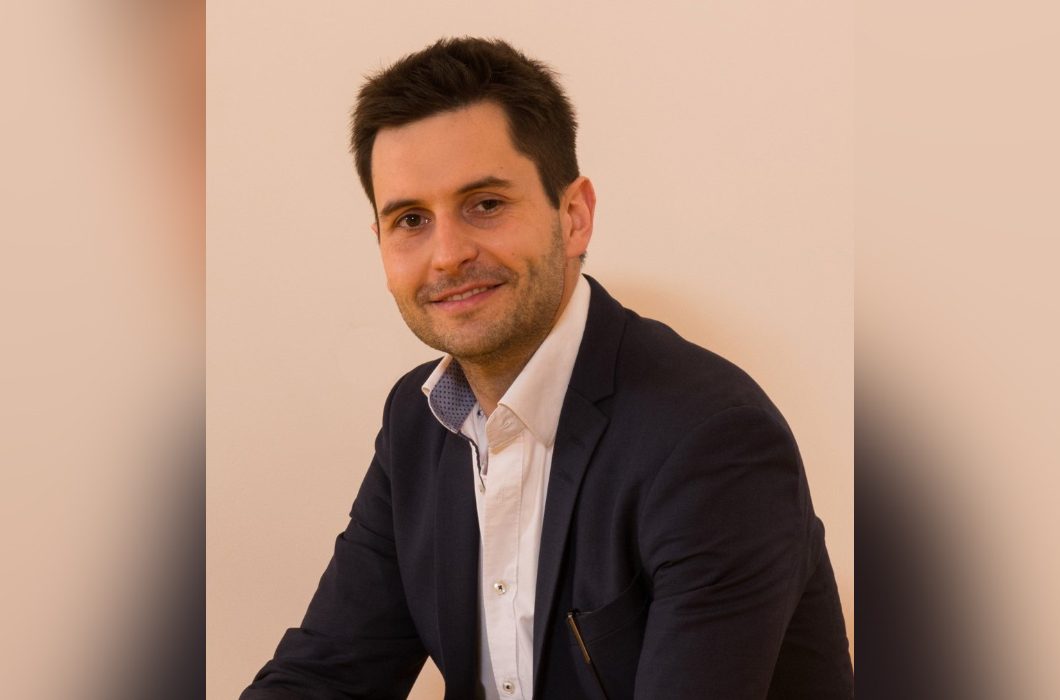
Source: Sebastian Walzel
"Build good networks early on! This applies to research just as much as it does to start-ups."
Do you already know which career path is right for you? Do you know how to get there and which steps are up next? The BAM career fireside chats series invite alumni and other partners of BAM to an informal chat focusing on their career paths. Developed for BAM’s early career scientists, this series aims to help PhD students and postdocs figure out which career path would be best suited for them. We invite a wide range of professionals from different sectors, including science, industry and the public sector. Additionally, we aim to include different professional backgrounds. We ask our guests about their experiences and invite the audience to ask questions.
Sebastian Walzel, you studied economics and physics - how does that fit together?
This fits together much better than it seems at first glance. You have to know that I started a PhD in finance at the Free University in Berlin after completing my Master's degree in economics and working in transaction advisory. If you look at some of the achievements and important researchers in finance, you will see that physics has been very influential. A good example is the valuation of derivatives in the financial markets. The formula that is used today for the valuation of call and put options could not have been derived without the solution of differential equations from thermodynamics. But I would also like to emphasise in particular how valuable the study of physics was for me as a founder and researcher. Studying physics essentially means dealing with problem solving. This is usually done in teams, as the problems are too complex for lone wolves. You deal with a problem together and find suitable approaches to solving it, which you then push to a solution together. There can hardly be a better preparation for founding a company in the technology sector. But of course my economic education also helped a lot. At its core, economic thinking deals with the challenge of using scarce resources optimally. That is elementary for a start-up with limited resources. And one last thing about research: The really interesting research today takes place at the overlapping areas of different disciplines. I can therefore only encourage everyone to look into other fields of research and to develop their own networks in promising directions.
At BAM you were part of the team for a spin-off in the field of ceramic additive manufacturing. What special memory/experience did you take with you?
It was a great privilege to pursue a common goal with such smart and enriching people. The transfer of research and the commercialisation of a technology are very complex tasks. You can only succeed if you pull together as a team and work in a very solution- and result-oriented way. We did that with great commitment. The department and BAM as an organisation have also been a great support and enabled us to succeed despite the restrictions imposed by Corona. We are very grateful for that.
What career advice do you have for young scientists?
I cannot emphasise one thing enough: Build good networks early on! This applies to research just as much as it does to start-ups. Be active and see the development of networks as an investment in your own success.
Are you a former BAM researcher? Did you work at BAM while pursuing your Ph.D.? Did you partner with BAM on a research project?
Stay in touch with BAM by joining the Alumni@BAM network! Simply register online here.