

MetrIAQ - Emissions of dangerous substances from building materials into indoor air
Project
-
Project period
06/01/2021 - 05/31/2024
-
Project type
EU project
-
Project status
Closed
Description
This project will develop reference products in order to improve the traceability chain and comparability of test procedures for the determination of gaseous emissions from building materials.
Location
Bundesanstalt für Materialforschung und -prüfung (BAM)
Branch Fabeckstraße
Unter den Eichen 44-46
12203 Berlin
Challenge
Given that European citizens spend more than 80 % of their time indoors, it is vital to have a healthy indoor environment. To achieve this, the release of harmful substances from materials used indoors must be minimised. Traceable measurement of emissions of volatile organic compounds (VOC) from such materials is essential. The project results will support the efforts to minimise the use of building products, that emit dangerous substances, thereby ensuring improved indoor air quality.
Objectives
Development of both emission reference materials (ERM) and gaseous certified reference materials (gCRM) for pollutants typically emitted from building materials and their thorough validation; development of a suitable numerical model for simulating the compound release into test chamber air enabling the prediction of the emissions for each of the selected target VOC; contribute to the standards development work of the relevant technical committees.
Methods
For the well-defined and stable release of VOCs from the ERM, reservoir materials will be developed and integrated in a suitable matrix. These can either be encapsulated pure VOCs or porous materials impregnated with the target compounds. Supplemented by a numerical model the emission rates will be made predictable. For demonstrating SI traceability of the gCRMs, gaseous primary reference materials (gPRM) will be produced having the closest metrological traceability.
Partners
Consortium
2 Metrological Institutes (TUBITAK UME, VSL)
1 Designated Institute (BAM)
6 external funded partners (Eurofins, Fraunhofer IMM, Politecnico di Torino, VITO, ZAG) from 7 European countries
Coordination
Dr. Matthias Richter, Bundesanstalt für Materialforschung und -prüfung (BAM)
Funding
The project receives funding from the European Metrology Programme for Innovation and Research (EMPIR).
MetrIAQ - Metrology for the determination of emissions of dangerous substances from building materials into indoor air
Overview
The release of harmful substances from building materials, such as paints, flooring, and from other products used indoors, such as furniture, into the air must be minimised. The overall aim of the project is to develop traceable measurement of emissions of volatile organic compounds (VOC) from such materials, by providing well-defined emission reference materials (ERM) and certified reference gas standards (gCRM), in accordance with the emission test chamber procedure described in EN 16516.
Objectives
The specific objectives of the project are:
To develop an emission reference material (ERM) that contains and releases relevant compounds typically emitted by construction products within the range of the EU-LCI list with a constant emission profile that decreases by less than 10 % over at least 14 days, in order to improve the quality assurance and quality control (QA/QC) of the emission test chamber method as described in EN 16516.
To develop gaseous certified reference materials (gCRM) of indoor air pollutants for compounds selected from key groups that are relevant for the health-related evaluation of building products as stated in the EU-LCI-list, such as aldehydes, unsaturated aldehydes, cyclic dimethylsiloxanes and glycol compounds.
To validate the newly developed ERM and gCRM by investigating the short- and long-term stability, reproducibility and uncertainty in an inter-laboratory comparison, thereby demonstrating the benefits of the reference materials for the test procedure described in EN 16516.
To develop a suitable numerical model for simulating the transport processes inside the ERM and the compound release into test chamber air enabling the prediction of the emissions for each of the selected target VOC.
- To contribute to the standards development work of the technical committees CEN/TC351 WG2 and ISO/TC146 SC6 to ensure that the outputs of the project are aligned with their needs, communicated promptly to those developing the standards and to those who will use them (e.g. test chamber operators and gas standards manufacturers), and in a form that can be incorporated into the standards at the earliest opportunity.
Project structure
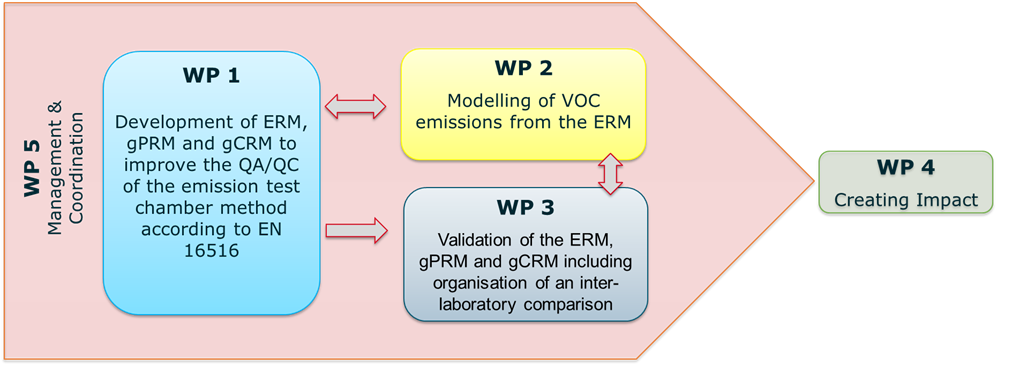
Work packages
WP 1 (not accessible) [PDF, 356 KB] Development of ERM, gPRM -- gaseous Primary Reference Material and gCRM to improve the QA/QC of the emission test chamber method according to EN 16516
WP 2 (not accessible) [PDF, 86 KB] Modelling of VOC emissions from the ERM
WP 3 (not accessible) [PDF, 310 KB] Validation of the ERM, gPRM -- gaseous Primary Reference Material and gCRM including organisation of an inter-laboratory comparison
WP 4 Creating Impact
Project coordination
Bundesanstalt für Materialforschung und -prüfung (BAM), Process Analytical Technology Division and Analysis of Artefacts and Cultural Assets Division Germany
Dr. Matthias Richter- MetrIAQ project leader, scientist, BAM Process Analytical Technology Division
Dr. Wolfgang Horn - scientist, BAM Analysis of Artefacts and Cultural Assets Division
Dr. Christoph Grimmer- scientist, BAM Analysis of Artefacts and Cultural Assets Division
Partners
TUBITAK UME Turkiye Bilimsel ve Teknolojik Arastirma Kurumu, Turkey
VSL B.V., Netherlands
Eurofins Product Testing Denmark A/S, Denmark
FhG IMM Fraunhofer Institute for Microengineering and Microsystems, Germany
POLITO Politecnico di Torino, Italy
VITO Vlaamse Instelling voor Technologisch Onderzoek N.V., Belgium
ZAG Zavod za gradbeništvo Slovenije, Slovenia
Publications
Metriaq publications on Zenodo
Events
Funding
The project 20NRM04 MetrIAQ has received funding from the EMPIR programme co-financed by the Participating States and from the European Union’s Horizon 2020 research and innovation programme.